Thursday, March 13, 2014

Darting a Confession

I have a confession to make:   I never (actually: no longer) mark darts in any traditional way.

There, I've said it  --  let the guilt of non-compliance and the fear of social reprisal set in.  [You know that neither of those keep me up nights, don't you?]

I, like most sewists, was taught to transfer the darts, and, indeed, all markings from the pattern tissue to the fabric via tracing paper and wheel.  If, like me, you truly mourn the destruction of a pattern that you love and intend to re-use; then, likely you have thought:  "there's got to be a better way."  In fact, there are several.  Here are some that I have considered over the years:
1) Fold back pattern tissue to edge of dart/pleat/tuck/fold/etc. and mark with dressmaker's chalk.
     Well, gee  --  that doesn't sound difficult, time-consuming, or potentially inaccurate at all, huh????
2) Same method with dressmaker's pencil instead of chalk.
    Same comment applies.
3) Trace the pattern, transferring ALL markings to more durable pattern-making material, and mark that up as you please, saving the commercial pattern for re-drafting ad infinitum.
     Many sewists do this.  One of whom I am related to by blood. {and isn't genetics amazing??}.  If there are many alterations to the pattern needed, or design changes desired, or, if the pattern is likely to be shared by several friends/family members, then this is a very good option.  If more than one of the above-mentioned criteria apply, then this is the method I recommend.  I don't do it, mind you  --  but I recommend it.  I find that this gets very expensive very quickly.  Some see the expense of  pattern drafting materials as protecting the investment in commercial patterns wise.  Considering the ever-increasing cost of patterns that nearly always require some alterations, I can see the point.  I, however, abhor the extra expense, and the need to store yet more pattern.  I nearly always hack up, fold down, or otherwise make the commercial pattern work!!
There's another reason I broke with tradition.  Other than basic rebellion, I mean.  Commercial patterns  are designed/engineered primarily by CAD (Computer-Assisted Design).  This means that darts, etc., are marked according to exact mathematical precision.  This is great if your body is proportioned according to exact mathematical precision, but perhaps you are normal?  If so, you might need the back dart on the left side a little deeper than the right.  Or longer.  Or curved.  Transferring those lines off the tissue don't seem such a good idea, now, do they?  Marking (with pins) only the beginning and terminus of the dart allows you to get the precisely the dart you want.  Isn't custom-control part of the reason you sew your own clothes?

4) Don't mark the fabric at all.  Just pin the dart/pleat/tuck you intend to sew.  Here's how:


With the pattern still attached to the fabric, place a pin at the head of each side of the dart (the dotted lines on the pattern).  Place another pin at the bottom of the dart, through the paper and fabric.


Fold back the pattern, and place another pin across the stopping point of the dart.  [BTW:  the very tip of a dart's point on the bodice of a woman's blouse is, professionally referred to as:  'the bust point'.  Why is it, that even women can't admit that breasts have nipples???  I do not understand this.  But, I digress  .  .  .]


Remove the pattern.  Bring the two vertical pins together, and pin the fabric together at this point, removing one pin.


Stitch the dart.


And here, I must make another confession:  I don't sew darts the way I was taught to anymore, either.  (and 6 generations of my family's women just spun in their graves, accompanied by Clothing & Textile teachers from High School and College)

I, like most of you, was taught to stitch darts from largest end to smallest (the point), back-stitching at the beginning, and tying-off the threads at the point.
Firstly, why are you backstitching the stitches that are made into the seam allowance??  Don't waste the time or the thread.  Hold the lose threads at the beginning of your stitching, and have at it!
Second, the point:  okay  --  tying off the threads works, but if the garment's fabric is sheer, they will show through.  ICK!  Here's what I do:
Begin at the wide end, yes, then as you close in on the point (you just pictured a nipple, didn't you?), reduce your stitch length poco a poco, ending with the tightest stitch your machine will do.  That stitch is secure, and you can lop off those threads right at the point.

Lovely!


Wednesday, February 5, 2014

Fuzzy-Wuzzy Blankie

I know.
A pieced, quilted, fur blanket is decadent - even for me.  I offer no apologizes for this.
You see:  it gets COLD up here on the mountain!!!   I have always maintained that, given a choice, I prefer a cold climate to a hot one.   Now, we all know why:  so that I have a reason (I do try to be pragmatic!) to sew, and wear, warm, fuzzy, soft, bulky and cuddly things.  Sybarite that I am, I love texture - and plenty of it.  Hence: this quilt.

This is not a typical quilt by anyone's definition of the term.
But then, I have never aspired to be typical.

I started with a kit for assembling a fake fur throw.
I read the directions, really I did.  I even thought I was following them.  However, the first instruction  --  "cut printed fur into 9 - 8in wide strips"  --  threw me.  I started cutting the strips, following the instructions to cut each fabric, single layer with scissors rather than a rotary cutter.  This I did, until after the 7th strip, when I ran out of fur.  S * I * G * H.   A closer look at the instructions revealed that there had been no mention of which direction to cut the strips.  Selvage to selvage??  Lengthwise??     I used the SWAG method and cut selvage to selvage, which gave me the longest strips.  The process deteriorated from there.
Once I was done cutting the fabrics as close to the instructions as I could, I proceeded to arrange the strips of fabric according to the photo on the front, and attach them to each other.  Having no advice on this from the instructions (it was roughly around this time that I tossed the instruction sheet into the recycling bin), I attached the strips with my serger set on a wide 4-thread, with Wooly Nylon in the upper looper.  So glad I thought to do that!!!   Fake fur creates A LOT of lint.  A LOT.  My cats loved chasing puffs of fur lint around the house.  My vacuum cleaner was less enthusiastic.

I could have pieced the strips, borders, and sashings together, and been done with it  --  that was the original design. [as near as I can remember].  But I didn't like the networking of serger thread that only matched some of the fabrics, showing.  Also, as I may have mentioned, it can get a tad nippy at this elevation, so I didn't think a warm backing, with tight, cotton batting between would hurt a thing.

Since I have taken the Stashbusting 2014 pledge, I couldn't run to a store, or website to buy backing fabric.  Not to worry  ---  for several moves now, I have carted around a thick cotton flannel fitted sheet that no longer fits any bed we own.  I couldn't get rid of it  --  it was great fabric.  I cut out the elastic (yes - I saved it.  I'll use it someday), and used the sheet for the backing.  It feels great!!!!


Black machine quilting thread (Gutterman) was used to stitch-in-the-ditch on the topside, using my Pfaff's Quilting stitch.  This is a back-and-forth stitch that, on the bobbin side, looks like hand-quilting. [which is as close as any project I ever make will come to actually being hand-quilted]


For binding, since this blankie was all about texture, I wanted a satin binding.  Behold!  My stash contained 3/4 yd. of a black crepe-back satin that I cannot remember buying or using. (!?).  It took some piecing, but there was just quite enough to make a wide bias bound edge.

When all is said and done, the most important thing you need to know,
 is that this blankie is kitty-tested,


and kitty-approved.


Monday, January 13, 2014

Project Reveal

Warning!  Serious cuteness follows:

I finished the Grand-girls' dresses.  Oh(!)  My stars!  I can hardly handle how gaudy-cute they are.  Really  --  the riot of bright and bilious pinks, paisley, dots and stripes is a significant affront to all that is tasteful.

Myra and Emma are going to love them!!!

I started with a pattern from modkid that was on sale @ Waechter's  (one of several places in Asheville that I plan to pleasantly haunt after I die).  This purchase was made in August, with no immediate plans for use.  That changed a couple of weeks ago, when a post-holiday sale at House of Fabric included 3 of the brightest Hot Pink prints at 60% off.  I made a wild guess and bought 3/4 yard of each.  Once I started laying the pattern out, I realized that my estimate was conservative in the extreme.  a quick trip to Needle Me This netted 2 more prints --  the pink/brown batik and the bright stripe  --  and a search through my  stash added the narrow stripe, solid (Emma's dress) and the pale pink spot (Myra's dress).

I mightn't have needed so much more fabric, had I omitted the hood  --  but, I had no intention of doing that!!!

The pattern proved interesting.  Instead of line sketches in the information sheet(s), glossy, full-color photos are used.  This seems like a good idea, and for me it was fine; but a novice sewist might find the plethora of details difficult to focus on.  A line sketch generally only shows the details that are pertinent to each step.  It didn't slow me down, since I use information sheets as a 'suggestion'; but I wouldn't suggest this pattern to someone who is just learning to sew.  Modkid patterns are best for a sewist with a little experience under his/her belt.
Otherwise the instructions mostly made sense, except for the hood.  I was instructed to completely construct the hood, and its lining, then set it aside until the bodice was completely constructed.  Why not just include its construction at the time it is attached???
Overall, these were fun to make!
I shall include pictures of the girls' wearing them, as soon as I receive them. [AHEM!!]


Added, 17 Jan 2014
As promised, some adorable pic's of one of the dresses, modeled by its new owner. 
I give you, HRC Myra, Princess of Hearts:


Sunday, January 12, 2014

Bustin' the Stash

Or, in my case:   the ST-A-A-A-A-SH.

I'll take that pledge:

     I, Sarah Colley Jones, aka:  SarahbelleSews, commit to fabric from my stash for at least 90% of all sewing projects in the coming year (2014); purchasing only such fabric or notions as are needed to complete a project that is 'stash-derived' in is genesis.

This should be fun!!

  Join us, won't you???

Flab update (sans photos)

Firstly:  why no photos???
So many reasons:
   1)  changes aren't profound enough to be visible, so  --  what would be the point?
   2)  it's awfully cold on the mountain, today, and this much goose-pimpled blue flesh in not at all appealing
   3)  can't find the blue polka-dotted swimsuit.

I shall, instead give what vitals I have.
This does not purport to be stupendous.  It has been very slo-o-o-o-o-o-w going.  Things started off nicely, with me attending a 12-week-long course of nutrition, exercise and behaviour modification taught at a local hospital.  It was a really good course, with some wonderful teachers, and great materials.  I can't honestly say that I learned a lot of new things (as an Extension Agent, I had all ready taken/taught much the same course, with many of the same materials); but, being accountable helped me stay on course.
Until I got a new job, that required immediate travel.
For 2 months I lived in a hotel, ate in restaurants, and never exercised.  I didn't even weigh myself.  I really didn't want to know.
Then the job started, and things went from bad to worse.  It was a horrible job, full of stress, late hours, crazy hours,  erratic eating schedule to NO eating schedule, and  --  did I mention stress???
The job now exists only on my resume (as I once again embark on THE JOB SEARCH), and my eating and exercising are back on track.  I'm even sleeping regularly. (!!)

Here are the numbers at this point, in what is proving to be a long journey:

Weight:  238     [down:  22 pounds]
BMI:      37.3    [down:  3.7pts.]
Bust:     49.5     [down: .5 in]
Waist:     45      [down:  3in.]
Hips:      52       [down: 4in.]
BP:        108/68    [down from (day I quit my job) 210/168]
Serum Glucose:  105   [down:  85]

So, my clothes aren't exactly falling off of me, but the ones that were uncomfortably snug, are now comfortable, and a couple of things that I couldn't even zip up 6 months ago now fit - more or less.  But the labs are far less scary-looking  (YAY!!!), and I am starting to feel better, sleep better, and have slightly more energy.

It's a nice, little start.

Friday, January 10, 2014

Sneak Peek

I have just started sewing matching dresses for my grand-girls  [aka:  Myra Moo and Emma Boo, whose nicknames not only rhyme with each other's, but also with, "I love you"].  No other details, yet, but some calico found on sale, and many scraps/remnants from my stash are involved.

Here is a picture of the hood:


Yes, I said: "hood".

I think it wants a Hot Pink tassel, don't you?

Monday, September 30, 2013

FINIS! (finally!!!)

OR:  why my next several quilting projects will be MUCH smaller.

This began as a "Mystery Quilt" retreat at my local quilt shop, Needle Me This.   Intended to teach quilting skills, it didn't take long for me to learn something about myself:  I don't like working on a project and not knowing my goal.  For me, "Mystery Quilting" is a bad idea.   This is no fault of the teachers or their excellent written instructions.  The step-by-step guide, augmented with sketches, was well-written, and did not miss any needed steps.  I  followed along, and achieved the desired results.  I just felt uneasy the whole time, not knowing if I was on the right track, or not.  Had their been a picture of the finished project, I would had caught on quicker, and enjoyed myself more.  That would, however, have defeated the purpose of the "mystery".  So, I learned something useful about myself.  Mission accomplished!

This quilt began with cutting fabric into 5 in squares, and those squares being sewn into a 4-patch of precise order.


Each of 120 4-patches was then sub-cut, and re-arranged, then re-sewn to make a pinwheel.


Then, each (of 120) pinwheels was sub-cut into 9 tiny squares, some of which were re-arranged, then re-sewn to make  a diamond, surrounded by bars.

Then, the newly re-designed squares were sewn together in a precise arrangement to make  a larger 4-patch which featured diamonds and crossed lines that resemble an Argyle plaid.


Fascinating as this was, I was starting to lose interest in the whole project.  Plus, looking at those tiny squares, diamonds, and bars was making me bleary-eyed.  And this process was to be continued until it was Queen-sized???  Not by this quilting queen!

So, I decided to let my creative juices flow!  With feedback from hubby, and daughter, I quit sub-cutting the pinwheel-squares (having made 120 of them assembly-line style), and sewed them together for a boarder.  then I added strips of batiks whose colors went with those all ready used, and repeated this process until I had pieced a Queen/King sized top. [reducing a process that may well have taken months, into 3 days]


                                     Ta da!!!


How do you like it?  As soon as the backing fabric (a cream and cafe-au-lait batik) I have ordered arrives, it is off to a friend with a long-arm quilter, to be quilted, then I shall bind it, and be completely done.  For now, I feel that most of my work is done, so I am finished.  Whew!!

One more thing:  I didn't realize it, until it was done, and hung for the pictures, but there is a major flaw in it.  At least, it is obvious to me.  No one else I have asked can find it, so I am disinclined to rip out 1000+ stitches and re-do it.  But, I am wondering if someone else might see it??

Ergo, I propose a contest:   to the first one of my eagle-eyed readers who finds, and can describe to me the flaw, I will give one whole piece of fabric from my stash of his/her choosing.  (from among the considerable array of choices I will make available). 

And now, I am off to cut out some clothes to make!!


Friday, September 27, 2013

Update

Well, shoot!

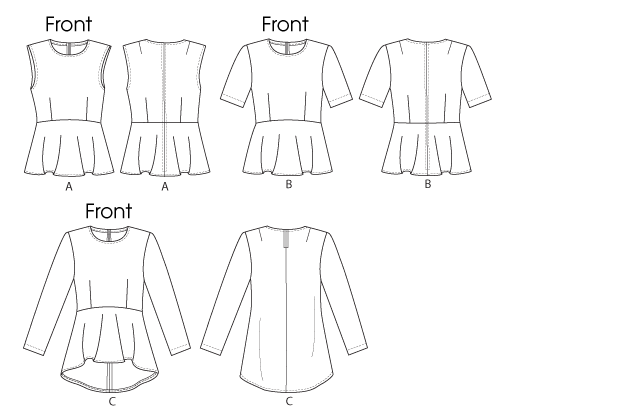
I opened the blog tonight to post about a completely different project than this, but discovered that I had started telling you about, and seeking opinions of, a blouse that I have now finished, and worn several times.

Mea Culpa.

So:  the V8815.
It turned out great!   I lengthened the hem about 4 inches, as it fell at a most unflattering [read:  FAT] point of my body that I prefer a garment to skim over  .  .  .  and I decided to do a tone-on-tone machine-embroidery CB embellishment.


Here's how I did it:


After serging the edges of the CB seam allowance (set my Baby Lock to "B", which is a narrow-ish ["D" is for rolled hems, by comparison], tight stitch), I pressed under  3/4 in., then threaded matching rayon embroidery floss in the needle of my Pfaff, and ultra fine gauge machine-embroidery polyester bobbin thread in the bobbin.  I selected a heart-trellis design, and stitched each side 1/4 in. from the folded edge, with the hearts facing in opposite directions.
Then it got really fun!   I needed to stitch these two back pieces together, so, after marking 6 in. from neck edge (for keyhole opening), and 6 in. from hem (for ease of movement, and to mirror neck opening), I abutted the two folded, embroidered edges together and connected them with an X-design fagotting stitch.

So easy!   So pretty!


Of course, the whole project started with this necklace, and my desire to have a 'backdrop' for it.


What do you think??

Tuesday, July 30, 2013

Can't Leave well Enough Alone

Today I cut out Vogue 8815 of a lovely pale pink Japanese lawn (100% long-staple cotton  -- and so lustrous!) that I bought @ Waechter's a while back.  [More on that in a later post]
After adding 4inches to the length, front and back, and raising the neckline an inch, I am mostly happy.


I like the several simple, but unusual design details in the front  --  but the more I
look at the long, straight back, the more inclined I am to embellish, somehow.


But, what?

Insert a circular godet @ lower CB to mimic the half-peplum in front??

Turn the CB seam into a placket, and cover with several artistic buttons??

Piping flanking a CB narrow panel?

Tone-on-tone embroidery detail from neck to hem??

I shall start stitching tomorrow or Thursday, so get your votes/ideas to me soon.

I anxiously await all of y'all's great input!!

Saturday, June 29, 2013

Quilt Project [so far]

I recently began a long-term project of constructing a queen-sized quilt.  When I described the steps involved (the greatly condensed version of the steps involved) to my daughter, she replied, "So, then, quilting is basically the most tedious form of sewing, ever?"  (This from someone who spins her own yarn, pre-hand-knitting???)
Well  .  .  . yeah, actually.  It is also very gratifying.  Also, unlike clothes sewn for ungrateful offspring, quilts are never out-grown  --  they always fit.

What follows is a small example of the tedium involved in quilt-piecing, and making.

Note:  I left out pictures of cutting each piece of fabric, and of pressing
 seams.  Talk about tedium???  Sheesh!!


First,  select basic fabrics.   I love batiks, and these three looked nice together.  The multi-color dominates the design.


Cut core fabrics into 5 inch squares.  480 of them.


Squares are sewn together in a 4-block,   (sorry  --  failed to take picture of this step), then sub-cut diagonally, switch halves (purple-coral, and purple-teal) and sew together to form pinwheel.


Sub-cut pinwheel 1.5 inches off center, rotate alternate blocks in outer rows, re-stitch to make this block:


Stitch together 4 blocks to make dominant square.


30, or so, of these squares sewn together make the quilt top which then resembles an argyle plaid.


It is coming along.  I have preformed up to step 3 with all of the fabric. I can't quite yet see the light at the end of the tunnel, but I can see the tunnel, rather than merely believing that it exists.

More photos IAW developments.

Wednesday, June 19, 2013

Swimwear Designers, and MBA, and Men


I recently viewed this incomparable video of Jessica Rey, MBA-turned-swimwear designer, who, in researching male perception of swimwear designs, decided that something needed to change.

Now, she designs her own line of swimwear.

This 9-minute video introducing her line is amazing.  Her research is solid.  Her conclusions are unusual.

Please watch the whole 9 minutes. You won't be sorry.


http://www.youtube.com/watch?v=WJVHRJbgLz8

Monday, June 17, 2013

Full Disclosure

Thought that might get your attention.

Actually, I'm only offering disclosure on one subject:  my weight, and tribulations, thereof.
I realize, that this is primarily intended as a sewing/quilting/needlecrafts blog.  However, when I began it, I did say that from time to time, I might discourse on non-sewing related subjects.  This is one of those times.

I have not blogged about a sewing project in nearly a year.  Some of you may have noticed. Some of you may have wondered the reason.  The reason is simple:  I haven't sewn anything in nearly a year.  The reason for that is somewhat more complex.

I have, over the years (decades, really) put on more than a few extra pounds.  And, while, I'm not at all crazy about the way the extra pounds make me look, this disclosure is not about a grand makeover regarding improving my looks.  [although if that happens  --  yippee!]  I do not  -- repeat, NOT  --  believe that fat = ugly.  How can anyone, when there are so many beautiful fat women in the world??  Delta Burke, the late Elizabeth Taylor, Melissa McCarthy all come quickly to mind.  I do not believe that fat is morally reprehensible.  I don't think fat is morally anything. I am not convinced that fat is automatically unhealthy.  I know fat women whose health I envy; and, of course, skinny women whose health is just sad.  In my case, however, there are health issues.
I am, and for over 25 years have been, hypertensive.  I am currently on 2 medications to control my blood pressure.  Granted, when I had my first TIA, I weighed 160 lbs.  At 5ft, 7in., my weight was not considered an issue (I asked).  Maybe, but the 100 pounds I have added since then haven't helped anything.  More issues have crept up over the years.  Joints ache (especially knees and hips).  Stairs are my enemy. Then, last week, the word I have feared for years was uttered: "diabetes".  When all the test results were in, the news was not as horrible as it might have been, nor nearly as horrible as originally feared.  Of course, the first report I saw listed my serum glucose level to be 890, prompting my SIL (Dr. Katie's hubby) to wonder why I wasn't in the ICU.  Turns out, the number on the consult I had been given to take to the lab was a typo. Still, the correct report of 190, is nothing to ignore.  After the results of a fasting GTT were in, the diagnosis was official:   I am pre-diabetic.   What does that mean??? In layman's terms, it means that God has granted me a wake-up call, that, given my education and training,  I don't even deserve; but am not stupid enough to ignore.  If I act now: eat healthily, exercise  every day and for the rest of my life, lose the excess weight, I can still reverse this.  I can be healthy.  I can run up and down the stairs.  I can play all day with my grandchildren (instead of in 10-minute blasts).  I can enjoy my life  --  hopefully, a longer one.

Today, I had a consultation with a Registered Dietitian.  This consult was the 1st step of a 12-week lesson/exercise/psych eval program that is designed to reverse Type 2 Diabetes, or prevent its onset for people like me.  The first homework assignment was to "come clean" regarding my history in fat, and my goals.  At the RD's suggestion (threw down the gauntlet, is what she did!), those of us with blogs were encouraged to go public, with words, stats and pictures.  Pictures????  Is she kidding????  No, she wasn't.

So, here they are.


UGH!   Are they as hard to look at, as they were to take?????  I should tell you:  the swimsuit I am wearing  is one I made


 over 20 years, and nearly 70 pounds ago. (yes -made! And,  I am proud to say:   the family tradition continues )  wow.  Lycra really stretches, huh?

Now for the stats:
height:  5ft.  6in.  {did I shrink?  I mad them measure me twice.  damn.}
weight: 260
BMI: 41
BP:  145/87  [controlled w/ meds]
Total Chol:   192
Serum Glucose: 190
stamina:  pffffffffft!

My goals include, but are not limited to:
Reduce or eliminate anti-hypertensive meds
Eliminate diabetes risk
Increase stamina
Increase flexibility  (that's just for better sex, but I'm not going into that here, or my kids will barf)
Sleep better/ more regularly
Have the ability to walk up flight of stairs without getting winded.
Live long enough to play with my grandchildren's children.


This promises to be a long journey.  I shall post updates as they appear.
I hope to be sewing something stunning for myself, soon.
Fingers crossed!!!

Tuesday, February 26, 2013

Contest!!!! {via Help request}


Here, Dear Readers, you get a chance to help a blogger, and novice quilt designer out.

I have a pattern for a log cabin quilt that, owing to careful selection of fabric, and even more careful arrangement of blocks, makes a heart.   {Awwwwwwwwww}
When I say, "I have a pattern", I mean that several years ago I saw this quilt hanging in a shop, thought it was lovely, and wanted to make it myself.  So, I whipped out a piece of scrap paper, and furiously sketched the quilt, then - because I am a terrible sketcher, I added copious notes to help the sketch make since.  It's not exactly a professional pattern, per se.  and, when I say, "per se", I mean: "not even close".

I am now ready to choose the fabrics for the quilt.

I've always wanted to render it in soft shades of greens (sage, mint, pistachio) and muted pinks, with the borders in ivory or cream.

Viola!  One of my favorite quilt shops' websites has just introduced a collection of prints from MODA that will fit the bill nicely.  Of course the collection's contents far exceed my need.
Hence the help/contest.

I need 2 greens that are close to each other in color values, 2 pinks that are similarly compatible, and an ivory or cream for framing the heart.

Please go to Old Country Store Fabric's website [link is embedded] and peruse the Paris Flea Market collection.

In the comments section below, list your recommendations for the fabrics I need to make this quilt.

I shall leave the contest open for a week or so, then, on 8 March I'll make my selection.

The person who suggests the colors that I decide to use, will receive a table runner made of the same fabrics.

Sound like fun????   I think so, too!

Tuesday, February 19, 2013

Where's Waldo's Sewist???

and, here, I steal  -- cut and paste, really  --  from my lovely, talented daughter's blog:


Want to find your sewing buddies??

Here in the blogosphere, I think we've gone a long way toward ensuring that none of us sews in isolation. We have this amazing community of sewist/seamstress/sewcialist (s) that share and communicate with each other about projects, fabric, notions, sales, all the stuff! We even occasionally get a chance to meet up with each other in real life, which I think we all agree is about the most fun ever!
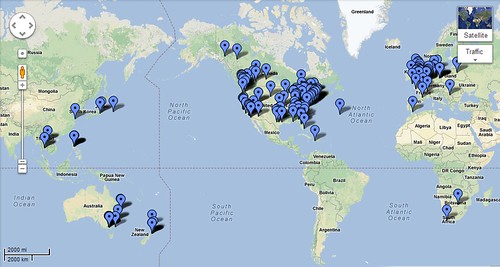
Well, in a brilliant move to help us find each other, Vicki at Another Sewing Scientist has compiled a map where we can all plot our approximate locations, so that we can find those who are nearby, and when visiting other places, link up with the local sewing crew.
So, since this is much more fun when we all play along, please head over to Vicki's post and get all the details about how to pin yourself.
 

I cannot at all take credit  for this great, fun idea; but, neither did I want anyone to miss out.

Thanks, @katie_kid_md, @laurahoj, @Ladykatza and all other sewistas who tweeted, blogged, FB'd, and narrowed our global village considerably!!

United, we create!!!

Thursday, January 31, 2013

Pahsmina vs. Shawl

Pashminas and shawls  --  they aren't the same!!!

Yes, I have both, and I'll show you some, directly.  But, for now:  a rant.  {Where did I put that soapbox??}

Twice in the past week I have come across shawls incorrectly labelled and marketed as "Pashminas". This kind of thing drives me nuts.

One of them, which I purchased (what? It was 75%off!!, and a lovely Blush/Beige color), was labeled, "Pashmina  100%wool  Made in China"   Wrong.  Close - but, no cigar.   The other (which I did NOT purchase) was labeled, "Pashmina   60% Viscose/40% Acrylic   Made in Guatemala"  So wrong, I scarce know where to begin.  Perhaps, some defining parameters are in order.

Wikipedia has this to say on the subject of pashminas:

Pashmina refers to a type of fine cashmere wool and the textiles made from it. The name comes from Pashmineh (پشمینه), made from Persian pashm ("wool"). The wool comes from changthangi or pashmina goat, which is a special breed of goat indigenous to high altitudes of the Himalayas in Nepal, Pakistan and northern India. Pashmina shawls are hand spun, woven and embroidered in Kashmir, and made from fine cashmere fibre.

[Sorry, Guatemala  --  you didn't make the cut.]

More wiki-elucidation:

"Pure pashmina is a rather gauzy, open weave, as the fibre cannot tolerate high tension. The most popular pashmina fabric is a 70% pashmina/30% silk blend, but 50/50 is also common. The 70/30 is tightly woven, has an elegant sheen and drapes nicely, but is still quite soft and light-weight."

I confess, 70/30 is my pashmina blend of choice, but I do have one that is 50/50, and it is lustrous, soft, and - not surprisingly - silky. 

The US Federal Trade Commission has this to say on the subject:
"Some manufacturers use the term pashmina to describe an ultra fine cashmere fiber; others use the term to describe a blend of cashmere and silk. The FTC encourages manufacturers and sellers of products described as pashmina to explain to consumers, on a hangtag, for example, what they mean by the term. As with all other wool products, the fiber content of a shawl, scarf or other item marketed as pashmina must be accurately disclosed. For example, a blend of cashmere and silk might be labeled 50% Cashmere, 50% Silk or 70% Cashmere, 30% Silk, depending upon the actual cashmere and silk content. If the item contains only cashmere, it should be labeled 100% Cashmere or All Cashmere. The label cannot say 100% Pashmina, as pashmina is not a fiber recognized by the Wool Act or regulations.[8]"

A quality pashmina is not cheap. They are made of fibers not in large production, require much personal handling, and,unless you live in the Himalayans, cannot be locally sourced. They are an investment, and you don't want to waste your money on a cheap fake. How do you know if it's worth the price? 

 Can you tell  by looking if it's a real pashmina?  Very possibly not.  Some of the fakes are very good.  When they are new.  Cashmere and silk are both very durable fibers.  Properly cared for (hand-wash, no wringing, air-dry; OR dry-clean.), you should expect to pass them on to your descendants.  Cheap acrylics, or wool of very poor quality will shrink, pill, distort, and not be color-fast over time.

Can you tell by feel?  Once you have worn, and loved, a true pashmina - oh, yes - you can feel the difference.

Several of my pashminas were purchased overseas, and thus, at tremendous discounts compared to US department stores.  This explains why I own several pashminas.  At $200.+ , I might only own 1 or 2.  Having purchased them in a country where labeling laws aren't so strict as in America, and, where I don't speak the local language, how did I know that I was buying real pashminas?  The feel and drape told me that I was likely dealing with good-quality cashmere, and  --  not to brag  -- but, even at a blend as low as 20%, I know silk when I smell it.  It's distinctive.  Still, I am unwilling to part with even a modicum of hard-earned money without reason, so, while my husband distracted the shopkeeper(s) in the Textile Souks in Dubai, I surreptitiously burn-tested fibers. I never bargin-shop for fabrics without my fiber ID-kit in my purse.  {Still can't believe I got that through Security at the airport unchallenged.}  If you are unfamiliar with burn-testing, or you want a  chart to keep handy, this one from the Sewing and Craft Alliance is wonderful!

Remember:  if the price sounds too good to be true  --  it probably is!!!  Also:  if the shawl is sealed up tightly in plastic: run!  Natural fibers are organic and need to breathe!  This, especially, includes your wedding gown, quilts, anything handed down from your grandmother.  Go!  Now! Right now, and get them OUT of their plastic bags, and wrap them in acid-free tissue, and place in an acid-free box.  NOW!!!
[Sorry.  The usually-latent archivist in me just reared her curly-topped head.]

Here are the promised pictures of some of my pashminas and shawls.  I love them all!!


These are 70/30 pashminas purchased in Dubai.  After several trips to dry cleaners, and one hand washing with Eucalan (the purple heather one - a favorite), they have retained their softness, warmth, lustre, and silky smell. 


These are not, strictly speaking pashminas, owing to the introduction of metallic threads.  The teal one, is however, a cashmere/silk blend.  The orange one is 100% wool. Both are beautiful, and cuddly soft!  They were purchased in Shanghai.


These are shawls.   The coral one is 100% silk, and the blue one is 100% wool.  Both were labeled, "pashmina".  The coral one was purchased at Ann Taylor, and the blue one at Nordstrom. 
S * I * G * H 

So, yes  -- buyer beware  --  but, not to the extent that you don't purchase, enjoy, and love a fine quality pashmina when you find it!!


Thursday, January 24, 2013

Skirts sans Pattern

Look:   no pictures!
I know  --  it's a little unusual to present a tutorial, and it not be accompanied by scads of photos.
They aren't needed, here  --  trust me.

I am going to instruct you in the ways of drafting, and constructing your own gored or panel skirt without purchasing a pattern, purchasing a kit, or looking at pictures.  All it takes are a few measurements, and a little Math.

Wait!  Wait!!  Don't leave!!!  It's very simple Math.  A little Arithmetic, and very Basic Geometry. I'm not going to ask you to name the Geometric principles involved, we're just going to use them.  Very simple.

What spurred this endeavor?  The other day I received an E-Mail from Nancy's Notions offering a kit to make a gored skirt.  My immediate response was, "Why would you buy a pattern for that, much less a kit?"  The answer, of course, is that if you didn't know my very simple Math Method, you would need some help.

At this point, I must digress and assure you that I mean no criticism of Nancy Zieman.  I am a great admirer of her, and her work.  I have learned much from the many books and DVD's she has authored that I own; and I am indebted to her. Also, if you ever are fortunate enough to attend Sewing & Stitchery Expo,  or any gathering wherein she is giving a class  --  sign up for it!  She's a hoot. For the perennially math-phobic who want a kit to make their first gored skirt, hers is an excellent one.

Now:  let's gather our equipment, and get busy.

You will need:
1) a sturdy (read: not yet stretched out of shape) tape measure
2) scratch paper (pull something out of the trash that was only printed on one side - recycle!)
3) writing implement (for the papers)

4) fabric  (you'll figure out how much, directly)
5) straight edge  (a yard stick works - so does a really big book)
6) drafting/pattern paper

Take your hip measurement.  Write that number down.  Move the tape measure up a little, and write that number down.  Move the tape measure down an inch or so, and write that number down.  Erase the two smallest numbers.  [I know  --  many sewing mavens instruct you to take your hip measurement 9 inches below your waist.  Others say to take it 7inches below your waist.  I have found that bodies come in many, many proportions.  Take several measurements, and use the largest one.]
Take your waist measurement.  Write that number down. [Aren't sure where your natural waist is? When naked - really - loosely tie a string or piece of yarn around your middle.  Twist, turn, bend, do this to music so that it's more fun.  The string will roll to your natural waist.]
To the hip measurement add 2 - 5 inches for ease  --  your choice - it's your skirt!
Take this number and divide by the number of gores/panels that you want.
To each of these numbers, add 1.25 inches (seam allowance).  This is the core measurement for each panel.
Did I lose you somewhere?  Let me illustrate with actual numbers:
We'll take my hip measurement:  38.  {What???  I had a 38in hips once!!  It was long time ago, but I remember it fondly.}

[38(hips)  + 4(ease)] / 6 (number of panels)  =  7 + 1.25 (seam allowance) = 8.25

At this point, decide how long you want your finished skirt to be.  Measure the distance from that point to your waist.  Add 5/8 inch for seam allowance at the waist, and an amount of your choosing for hem.
On your drafting paper, draw a rectangle the width of your core panel, and the length you just decided.  This is your jumping-off point. This is also where you figure out how much fabric you need.  Seam allowances have already been added, as has the hem, so measure the length on your panel.  When you select your fabric, its width will determine how many panels you can fit across the width of fabric.  2 panels, side-by-side?  You will need 3X the length of each panel.  3 panels, side-by-side?  You will need 2X the length of each panel.  See?  Easy Math.
 
Now for adjustments:
It needs to narrowed at the waist.  You have some options, here.  You could insert elastic at the waist and be done with it. If you choose a lot of ease, and plan to put considerable flare at the bottom (we're getting to that.), this is a very cute, feminine option.   If, however, you are looking for a more polished look, I suggest narrowing each seam allowance. Here's how it's done:
Calculate the measurement for each panel in same method as above, starting with your waist measurement.  Thus, my long-ago waist of 26 would net:

[26(waist) + 2(yes, I want less ease at waist than hip)] / 6 (number of panels) = 4.6 + 1.25 = 5.85

Subtract measurement at waist from measurement at hips for each panel: 8.25 - 5.85 =2.4
2 and a half inches needs be reduced at the waist of each panel.  Divide that by 2 (seam allowances on each panel), and you are reducing each seam allowance by 1 1/4 inches.

With your pen/pencil, make a mark 1 1/4 inch from the edge of each rectangle at the top (You choose which end is waist and which is hem by this step. Label accordingly.) Make another mark where you judge your hip to be. (Refer back to first step.).  Using straight edge, draw a line between waist and hip marks.  Cut away excess paper. {NOT with your fabric scissors!!!!}

Now for the really fun part.  You get to play with design options!
Do you want a simple, dignified straight skirt?  If so, you are done with paper, you may start laying it out and cutting.  Don't forget to save fabric for a waistband.
Do you want a full, fun, kicky, swirly skirt??  These panels are about to become gores.  A gore is simply a panel that is somewhat bell-shaped.  Accomplishing this is all about proportion. I know, more Math.  But, it's Math you get to wear!!  Copernicus never promised you that , did he?
A bottom width that is twice the original width will net a gentle flare in a soft fabric with a lot of drape, or a decided 'pouf!' in a fabric with a stiffer hand.  A 50% increase will take your straight skirt to a faux A-line.  I recommend experimenting with paper.  A  sheet of print paper will net you 2 or 3 gores of various dimensions that will give you a good idea of the finished product.
Want a really, really, really full, flared bottom to your skirt??  Godets to the rescue!!  In an upcoming post.

If you would like to see a finished example of this method, I can refer you to my earlier post, The Skyline Skirt.

If the  majority of you feel that I goofed, and pictures are, in fact, warranted to help you understand  --  then please leave me comments saying so, and I shall happily write a new post on the subject - with pictures.

We're all in this together  --  let's have some fun, helping each other create!!!


Tuesday, December 18, 2012